Road signs
For a full presentation of the case for converting the UK’s road signs to metric units,
see UKMA’s publication, "Metric signs ahead", which can be downloaded at
this link.
On this webpage we trace the history of the Department for Transport’s (DfT’s)
unwillingness to fall in line with Government policy on metrication.
The lack of significant progress on converting road signage in the UK to metric units is perhaps
the most obvious and visible example of successive governments' failure to carry through the
changeover which was begun in 1965. To quote the 1972 white paper
"It had previously been proposed that speed limits should be made metric in 1973 but on 9
December 1970 the Minister for Transport Industries announced in Parliament that this would
not be done and that the Government had no alternative date in mind."
(Hansard, 1970, quoted in the
White Paper of the Department of Trade and Industry, 1972 , paragraph 107).
Since then, there has been little progress toward the objective of converting road signs.
In 1989 the UK Government secured a derogation permitting the UK to "fix a date"
for this conversion, but there was no indication of what that date might be nor even of when the
date would be fixed. Indeed, in response to the publication of "Metric signs ahead"
in 2006, the DfT made it clear that it had no plans carry out its obligation, which a
spokesperson described as "a waste of taxpayers’ money".
In 2007, the DfT requested the European Commission to propose the complete removal of the obligation
to fix a date for converting road signs to metric. The Commission duly obliged, partly on grounds
of "subsidiarity", and the resulting amendment to the Directive was finally agreed in 2009.
Contrary to popular myth, there has never in fact been any pressure from the European Union for
the UK to convert its road signs, and the amendment has made little practical difference.
Needless to say, this change in EU law in no way detracts from the case for converting the UK’s road signs.
Height and width restriction signs
In September 2009, despite the its implacable opposition to general metric conversion, the DfT proposed
that within 4 years imperial-only height and width restriction signs (roundels) should no longer be
permitted and should be replaced by dual metric/imperial signs. Similarly, imperial warning signs
(red triangles) should only be used in conjunction with an accompanying metric sign
(The difference between the rules for roundels and triangles is that the triangular shape prevents
both metric and imperial units appearing on the same sign).
Imperial-only roundel signs (left) will be replaced with dual metric/imperial signs
An imperial warning sign (left) will have to be accompanied by a metric sign (right)
Although this move is welcome as far as it goes, the DfT has made it clear that it is
"a specific solution to a specific problem"
(i.e. disproportionate numbers of bridge strikes by foreign lorries) and is not part of any long
term conversion plan. It should also be pointed out that the UN-sponsored Vienna Convention on
Road Signs and Signals (an international treaty to which the UK is a signatory) specifies exclusively
metres on height, width and length restriction signs.
DfT objections to metric conversion
The DfT’s objections to conversion are longstanding but have changed over the years. The original
postponement of the 1973 target was clearly the result of a successful campaign by politicians opposed
to metrication generally, but the then Minister was careful not to rule out conversion at some time
in the future, and the 1972 White Paper commented that "The change of speed and distance signs to metric
units will need to be considered in detail, but not for some years."
Since then, the objections have been, variously, that
-
Drivers who have not received metric education at school would be confused by a change to metric units
(Parliamentary Written Answer, 11 July 2002, Hansard, Col 1116w) Subsequently, it was suggested that
conversion might be considered when a majority of drivers had received metric education.
[Comment: This point has almost certainly already been reached.
This is because metric units have
been mandatory in state schools since 1974, and therefore all drivers who were born after 1964 will
have received their secondary education using metric units. In any case, evidence from other countries’
changeovers demonstrates that such "confusion" is not a significant problem.]
-
Dual signage (i.e. metric and imperial on the same or adjacent signs) would be confusing – and therefore
dangerous in a safety-critical environment (quoted from a letter from the Permanent Secretary, 2003).
[Comment: However, distance signage is not "safety-critical";
speed limits would obviously NOT be dual signed; and the DfT already authorises dual units on height
and width restriction signs – which ARE "safety-critical"].
-
As the two previous arguments had lost any validity they might have had, in 2006 the DfT produced a new
argument: Cost. They claimed that the cost of conversion, estimated at
£680 - 760 million (ca. £1400/sign)
would be disproportionate to the benefits for transport and is not a priority for scarce resources.
With regard to the costs argument, several points should be made:
-
Although there are clear benefits for transport, the overwhelming benefit would be to society as a whole,
as it would no longer be necessary for functioning adults to have to be familiar with two systems of
measurement. By insisting on maintaining a separate, stand alone system for road signs, the
DfT bears much of the responsibility for perpetuating the UK’s measurement confusion.
-
The costs have been grossly exaggerated – possibly deliberately. It is palpably absurd to claim that
the average cost of amending or replacing road signs is £1400/sign
[See this link for details].
The DfT is guilty of “shroud waving” in order to protect its budget.
-
Even if the DfT cost estimate were credible, it is still a tiny proportion of total transport expenditure,
and is capable of being spread over several years and partially absorbed within existing budgets.
-
All other sectors of the economy have already absorbed the costs of change within their own budgets.
Manufacturing industries have retooled their factories, retailers have invested in new scales and
retrained their staff, schools have redesigned syllabuses and purchased new textbooks – yet the DfT
has continually sought to postpone the inevitable –
thereby actually increasing the eventual cost
(as any additional new imperial signs will have to be amended or replaced).
This failure to even begin to plan for metric conversion of road signage is particularly serious and indeed
wasteful since, if such a plan existed, any new imperial signage could be installed in a way that minimised
future conversion costs. An example of the DfT’s wasteful approach is the installation on motorways of
electronic variable speed limit signs that are not capable (without amendment) of showing the three digits
that could be needed to display higher speed limits (e.g. 100 km/h).
This variable speed limit sign cannot, without modification, accommodate more than two digits – hence, only
speed limits up to 90 km/h
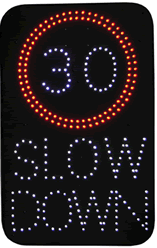
Even worse are the LED speed limit signs activated by drivers, which are not capable of amendment,
as in this example:
UKMA therefore calls upon the UK Government without further delay to announce the date when the UK's road
signage (and hence speed limits) will be converted to metric units. (This date should be as soon as reasonably
possible taking into account the time required to pass the necessary legislation and physically replace or
amend the imperial signage. Based on other countries' experience it is believed that this date could be within
three to five years of the announcement.
As indicated above, UKMA considers that the conversion of distance signage could (as in Ireland) be spread
over an extended time period, but we do not favour a long transitional period during which both imperial and
metric signs are in place. We are particularly opposed to the erection of new distance signs displaying both
units on the same sign
as we feel that such signs would become permanent and drivers would have no incentive
to adjust to metric units. Whether the changeover should be by totally new signs or by amending existing signs
is a matter for detailed consideration.
Many existing signs can be easily amended with overlays or riveted plates
The changeover arrangements should also include the use of the correct international symbols, including "km/h"
to denote "kilometres per hour". In particular, the erection of further signs giving "m" as an abbreviation
for "mile" should be prohibited with immediate effect.
The changeover programme will also need to include legislation to revise speed limits, revision of various
Regulations, including the TSRGD and the Road Vehicles (Construction and Use) Regulations to require legible
"km/h" on speedometers, together with an intensive campaign of driver education shortly before
and during the changeover.