
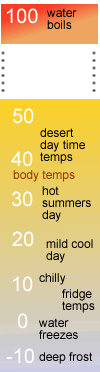
 On the Celsius scale water freezes at 0 degrees and (under normal everyday conditions) boils at 100 degrees. It is useful because the freezing point of water plays a critical role in assessing environmental conditions, such as the weather and in tasks such as storing and cooking food.
Become used to using only Celsius. If possible, buy a thermometer without Fahrenheit markings. See our metric supplies page or buy one next time you visit the Continent.
Get to know the temperatures involved in health and safety. See our Think Metric web site for further guidance.
If you have trouble remembering key points on the Celsius scale try the following rhymes:
| When it’s zero it’s freezing, when it’s 10 it’s not when it’s 20 it’s warm when it’s 30 it’s hot. |
OR | 30’s hot 20’s nice 10’s cold zero’s ice |
A bit of scientific background
Please note that what follows is purely for interest. It is not necessary in order to understand Celsius in an ordinary everyday context.
Technically, the primary unit of temperature in the modern metric system is the kelvin. The Kelvin scale of temperature is such that at zero kelvins (written as 0 K), a body of matter is totally devoid of heat energy. You literally cannot get any colder than that and there are no negative numbers. At absolute zero (The Kelvin scale is also known as the absolute scale of temperature) everything is frozen, even gases such as hydrogen. In fact, water remains as ice until it reaches a temperature of 273.15 K.
This is where the Celsius scale of temperature comes in. At 0 °C water begins to melt. The Celsius scale is the one we tend to use for practical everyday purposes and is still part of the international metric system. It relates to the kelvin in a fairly simple way. To convert to kelvins just add 273.15 (compare that with converting between degrees Celsius and Fahrenheit).
You only need to add or subtract 273.15 when converting between degrees Celsius and kelvins because the value of the difference between two temperatures is the same using either scale, i.e. a rise or fall in temperature of 1 K is the same as a change of temperature of 1 °C. Notice also that the degree symbol ° is used only with Celsius, not with the kelvin.
 UK Metric Association