
Despite the fact that there was a broad cross-party consensus in favour of adopting the metric system in Britain in the 1960s and 1970s, there have been a number of common objections raised to completing metrication in recent years. These include:
- The metric system has been imposed on Britain by Brussels bureaucrats
- Metric is foreign, Imperial is British. It is unpatriotic to use metric
- The World’s only superpower uses Imperial. Britain should do the same
- Older Britons cannot learn metric
- The market – not the Government – should decide which units are used.
For a more detailed discussion on the objections to metrication see our Myths page in the Why metric? section.
The metric system has been imposed on Britain by Brussels bureaucrats
This oft-repeated objection to completing the metric conversion in Britain misrepresents history.
The timeline for Britain adopting the metric system comprehensively starts in the 19th Century. Britain’s scientists contributed to the development of the metric system as a modern set of units including electrical as well as mechanical measurements. Full adoption of the metric system was recommended by an 1895 Select Committee but failed narrowly in Parliament in 1904.
In 1951 the UK Board of Trade recognised that the metric system was a “better system” of weights and measures than imperial and saw its introduction as inevitable. In 1965 the decision to go metric was announced in Parliament at a time when the prospects of successful entry to the European Economic Community (EEC) were bleak due to General de Gaulle’s famous “non” to Britain’s membership applications. Thus Britain decided to adopt the metric system over 7 years before joining the EEC.
When Britain joined the EEC, its endorsement of the metric system was merely confirming previously agreed British policy.
Metric is foreign, Imperial is British. It is unpatriotic to use metric
To reject something simply because it is ‘foreign’ is both xenophobic and irrational. To reject metric units because they originate in France is like rejecting motor cars because they were invented in Germany or rejecting air travel because the aeroplane was invented in the United States.
Some metric units such as the kilogram, were first adopted in late 18th century France. However, since the Metre Convention of 1875, the development of the metric system has become a truly international effort. Britain has participated in the development of the metric system for over a century. So just as telephone standards are subject to international agreement through the International Telecommunication Union (ITU), the metric system is subject to international agreement through the Metre Convention. The telephone system is not ‘foreign’; neither is the metric system.
Britain signed the Metre Convention in 1884. British scientists have significantly contributed to the development on the modern metric system.
Imperial units, like metric ones, have roots abroad. Although the name “imperial” refers to the British codification of units in 1824, imperial units have their origins further back in time. Many so-called imperial units are based on Roman units imposed across Europe as part of their Empire. Thus although the word pound is linguistically related to the modern German Pfund or Dutch pond, the abbreviation ‘lb’ comes from the Latin libra, and the abbreviation for ounce ‘oz’ comes from the Italian onza. There are two variations on pounds and ounces in the imperial system: avoirdupois (“goods of weight”) comes from the time in the 14th Century when London merchants adopted a French approach to weighing; while troy measure is based on the system used in the town of Troyes in France. Thus, far from being truly home grown, pounds and ounces have their roots in Italy and France.
Similarly, the mile is Roman in origin – the name being derived from the Latin mille passus, meaning 1000 (double) paces.
The Fahrenheit temperature scale was imported too. It was invented by a German who was born in Gdansk, Poland, and worked in the Netherlands.
Britain’s citizens deserve the best set of units. Metric is a better system so it is patriotic to support metrication.
The World’s only superpower uses Imperial. Britain should do the same.
It is true that the United States has been slow to adopt metric units. Nevertheless metric usage is increasing there (see the US Metric Association website).
To base Britain’s measurement unit policy on a single trading partner (even if it is a superpower) would be short-sighted. It would also run contrary to Britain’s economic interests as only about 12% of Britain’s trade is with the United States.

Furthermore fully metric nations such as China, Germany, Israel, Mexico and Japan have no difficulty in trading with the United States. For example, Mexico sends 82.7% of its exports to the US.
Older Britons cannot learn metric
Some older people find it harder to cope with change. However, to block progress by saying that older people cannot cope is patronising. The same argument could have been used to stop the introduction of decimal currency.
If properly prepared, with practical information and help available, there is no reason why older people cannot adopt metric units, as many have done. The transition to decimal currency was a success with young and old alike because of a well planned transition and plenty of information. The fact that British governments have provided virtually no information when introducing metric units is appalling.
The populations of countries like Australia and South Africa – young and old managed to adopt metric; Britain should be no different.
The market – not the Government – should decide which units are used
A single set of measurement units has been a foundation of consumer protection in every country. The principle was even recognised in Biblical times.
To let the ‘market’ decide which units to use is to open the door to confusion marketing around measurement units. Prices cannot be transparent if different units are in use in parallel. How can a customer compare the price of 100 g of prawns with the price of 2 pints?
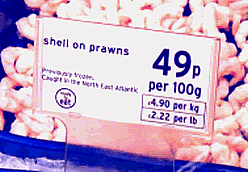

A market with no unit regulations simply gives every retailer an incentive to use the smallest available unit. This helps to explain the rapid adoption of the litre at filling stations (1 litre is less than 1 gallon) and the resistance to adopting kilograms (1 lb is less than 1 kg).
 UK Metric Association